Euclid in Urdu
Vernacular geometry, Muslim education, and the cultural lives of the Elements in nineteenth-century South Asia
Overview: In the nineteenth century, Euclid’s Elements was translated into Urdu and taught in North Indian colleges, largely through the work of Munshi Zakaullah of Delhi. A significant number of his books survive and have largely been ignored in the history of mathematics. The project asks what happened to the Elements when it crossed into Urdu. Which English editions did Zakaullah work from? How did he render proof and diagram? What did he keep from the Arabic and Persian Euclids? And what did the whole undertaking mean for a reform movement that put Western mathematics at the centre of Muslim education? I am looking for collaborators: mathematicians, historians, mathematics popularisers, mathematics teachers, translators and linguists.
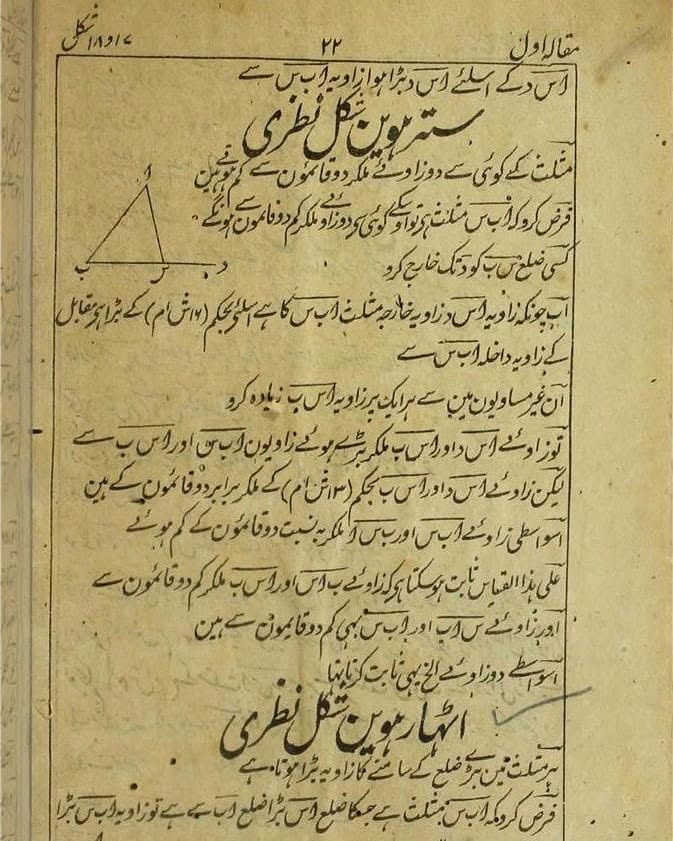
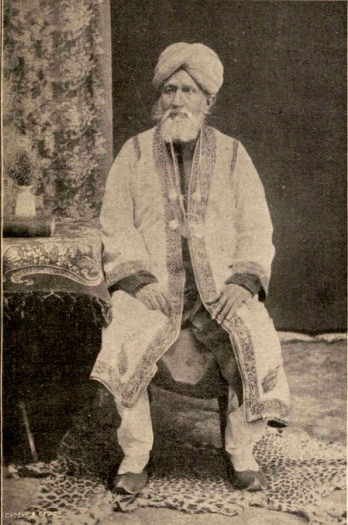
Right: Munshi Zakaullah in later life, from The Modern Review (April 1911).
In the second half of the nineteenth century, Euclid’s Elements was read, translated and taught in Urdu in North India. The central figure is Munshi Zakaullah (1832–1910). He studied and then taught mathematics at Delhi College, and from 1872 to 1887 was professor at Muir Central College in Allahabad, teaching Western science through Urdu. His mathematical and educational writings formed part of the Aligarh movement, the reform initiative that reconfigured Muslim education by incorporating Western scientific and mathematical learning. Urdu was its principal medium of instruction. His Euclid translations and pedagogical writings were used in classrooms at institutions such as Delhi College, Muir Central College and the Oriental College in Lahore. The translations drew primarily on English editions, including those of Isaac Todhunter and Robert Potts. Persian and Arabic Euclidean traditions continued to circulate in South Asia alongside them.
The question is how a text long central to European educational life acquired new meanings when rendered into Urdu, embedded in reformed curricula and mobilised within Muslim reformist visions of modern education. And how, in turn, these practices reshaped both Euclidean geometry and local mathematical cultures.
Some of the surrounding history has been written. Benjamin Wardhaugh’s Reading Euclid project, with Philip Beeley and Yelda Nasifoglu, reframed the Elements in early modern Britain and Europe as a historically situated text. It was shaped by reading, annotation, pedagogy and material production, not handed down as a timeless authority. For South Asia, Gregg De Young and Sonja Brentjes have examined elite encounters with Euclid mediated through Persian and Arabic mathematical traditions in the late medieval and early modern periods. Gail Minault and Dhruv Raina have studied Euclid’s institutionalisation in nineteenth-century colonial mathematics education, at Delhi College among other places. Karine Chemla’s work on mathematical proof has shown how European scholars used Euclidean norms to evaluate non-European traditions. What remains is a sustained, text-centred history of Euclid in North Indian vernacular contexts, and in Urdu in particular. The corpus has received almost no attention as mathematics.
A good number of Zakaullah’s books survive in digitised form, among them textbooks, translations and treatises on how mathematics ought to be taught. They are the heart of the project. Around them sit the records of the Scientific Society and the Muhammadan Anglo-Oriental College at Aligarh, the colonial education reports and examination syllabi of the period, and the English Euclids that Indian schoolboys were set to read. Read together, these can show what the Elements was doing in a Muslim classroom in the late 1800s, and what Zakaullah and his contemporaries were doing to it in return. That exchange, in both directions, is what the project is after.
The Urdu chapter of Euclid’s history has not been written, and I would rather not write it alone. Mathematicians who can read a proof and tell a good translation from a bad one. Historians, of mathematics or of colonial India, who know the archives in Aligarh and Lahore. Translators and linguists who are at home in the Urdu of the nineteenth century, which is not quite the Urdu of today. Teachers and popularisers of mathematics who can see what these books might still do in a classroom. And, further down the road, a partner for a bilingual edition of Zakaullah’s Euclid, so that the book can be read again rather than merely studied.
If that is you, write to me.
Acknowledgements
I am grateful to Dr Benjamin Wardhaugh of the Faculty of History, Prof Christopher Hollings of the Mathematical Institute, and Dr Alexy Karenowska of the Department of Physics, all at the University of Oxford, and to Dr Yelda Nasifoglu of the Faculty of Architecture and History of Art, University of Cambridge, for their advice and encouragement in the early stages of this project.
Further reading
- Reading Euclid: Euclid’s Elements of Geometry in Early Modern Britain and Ireland, AHRC project, University of Oxford (2016–2018).
- Wardhaugh, B., Beeley, P. and Nasifoglu, Y. Euclid in Print, 1482–1703: A Catalogue of the Editions of the Elements and Other Euclidean Works, version 2 (2025).
- Wardhaugh, B. ‘Euclidean terms in European languages, 1482–1703’, Historia Mathematica 68 (2024), 22–37.
- Beeley, P., Nasifoglu, Y. and Wardhaugh, B. (eds). Reading Mathematics in Early Modern Europe. Routledge, 2020.
- Wardhaugh, B. ‘Defacing Euclid: Reading and Annotating the Elements of Geometry in Early Modern Britain’, in A.-S. Goeing, G. Parry and M. Feingold (eds), Early Modern Universities: Networks of Higher Learning. Brill, 2021, 262–282.
- De Young, G. ‘Euclidean geometry in the mathematical tradition of Islamic India’, Historia Mathematica 22 (1995), 138–153.
- Brentjes, S. ‘Patronage of the Mathematical Sciences in Islamic Societies’, in E. Robson and J. Stedall (eds), The Oxford Handbook of the History of Mathematics. Oxford University Press, 2009, 301–328.
- Minault, G. ‘Qiran al-Sa’adain: The Dialogue between Eastern and Western Learning at the Delhi College’, in J. Malik (ed.), Perspectives of Mutual Encounters in South Asian History, 1760–1860. Brill, 2000, 260–277.
- Raina, D. ‘The Phased Institutionalization of Mathematics Education and Research in Late Colonial India (1850–1950)’, Archives Internationales d’Histoire des Sciences 66, no. 176 (2016).
- Chemla, K. (ed.). The History of Mathematical Proof in Ancient Traditions. Cambridge University Press, 2012.
- Todhunter, I. The Elements of Euclid for the Use of Schools and Colleges. Macmillan, 1867.
- Potts, R. Euclid’s Elements of Geometry: The First Six Books. Longman, Green, and Co., 1865.
- Andrews, C. F. Zaka Ullah of Delhi (1929). Reissued with introductions by Mushirul Hasan and Margrit Pernau, Oxford University Press, 2003.
- Pernau, M. (ed.). The Delhi College: Traditional Elites, the Colonial State, and Education before 1857. Oxford University Press, 2006.
- Chughtai, M. I. (ed.). Qadeem Dehli College (in Urdu). Lahore.
- Abbas, A. (ed.). Sir Syed ki Scientific Society (in Urdu). Majlis-e-Taraqqi-e-Adab, Lahore.